Project
Co-Creative Hub for Fostering a Green Job Market
through Gastronomy Geopolitics
Regional Co-Creation Area,
COI-NEXT (Program on Open Innovation Platform for Industry–Academia Co-Creation),
JST
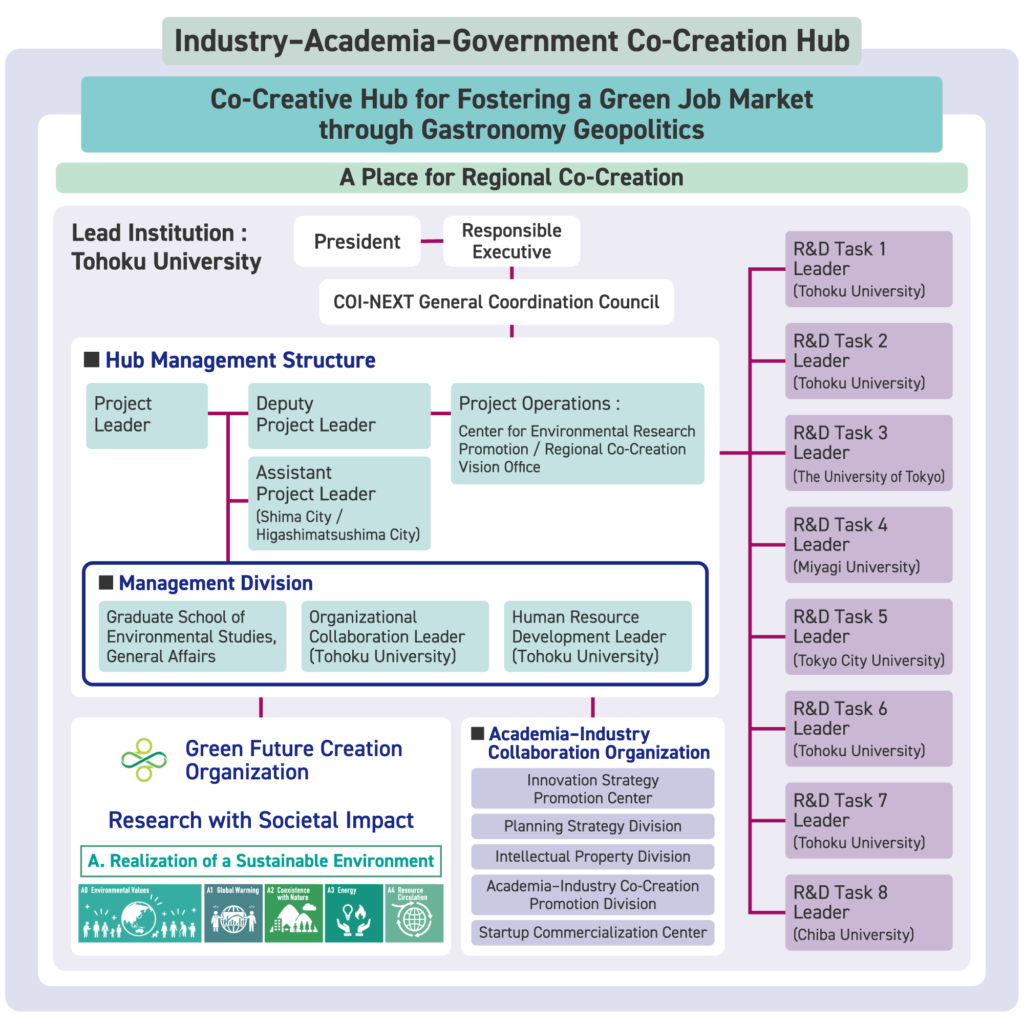
Primary industries are highly vulnerable to the intensifying impacts of climate change, with marine ecosystems experiencing particularly rapid transformations. While local food cultures—shaped over generations—must now adapt to these environmental shifts, food remains one of the most deeply rooted and culturally conservative domains. There is a notable academic gap in understanding the environmental and ecological foundations that support primary industries, and in adapting food culture to climate change. This project addresses that gap through research and development driven by the academic community.
In addition, to promote the effective use of underutilized agricultural, forestry, and fishery resources, the project engages in collaborative system design with governmental bodies through shared problem recognition and public awareness initiatives. Local high schools will also join the project to co-develop products with local businesses using untapped resources, while contributing to the creation of green jobs and to the establishment of platforms that support co-creative education.
Through this integrated initiative, the project aims to foster a green job market that encourages younger generations to see environmental sustainability as a career anchor—a core value that guides their choice of profession. It classifies employment related to the supply and consumption of primary natural resources—such as environmental management and conservation, the utilization of underused resources, and their distribution and provision—as green jobs, thereby contributing to the creation of future employment opportunities in regional communities.
Vision
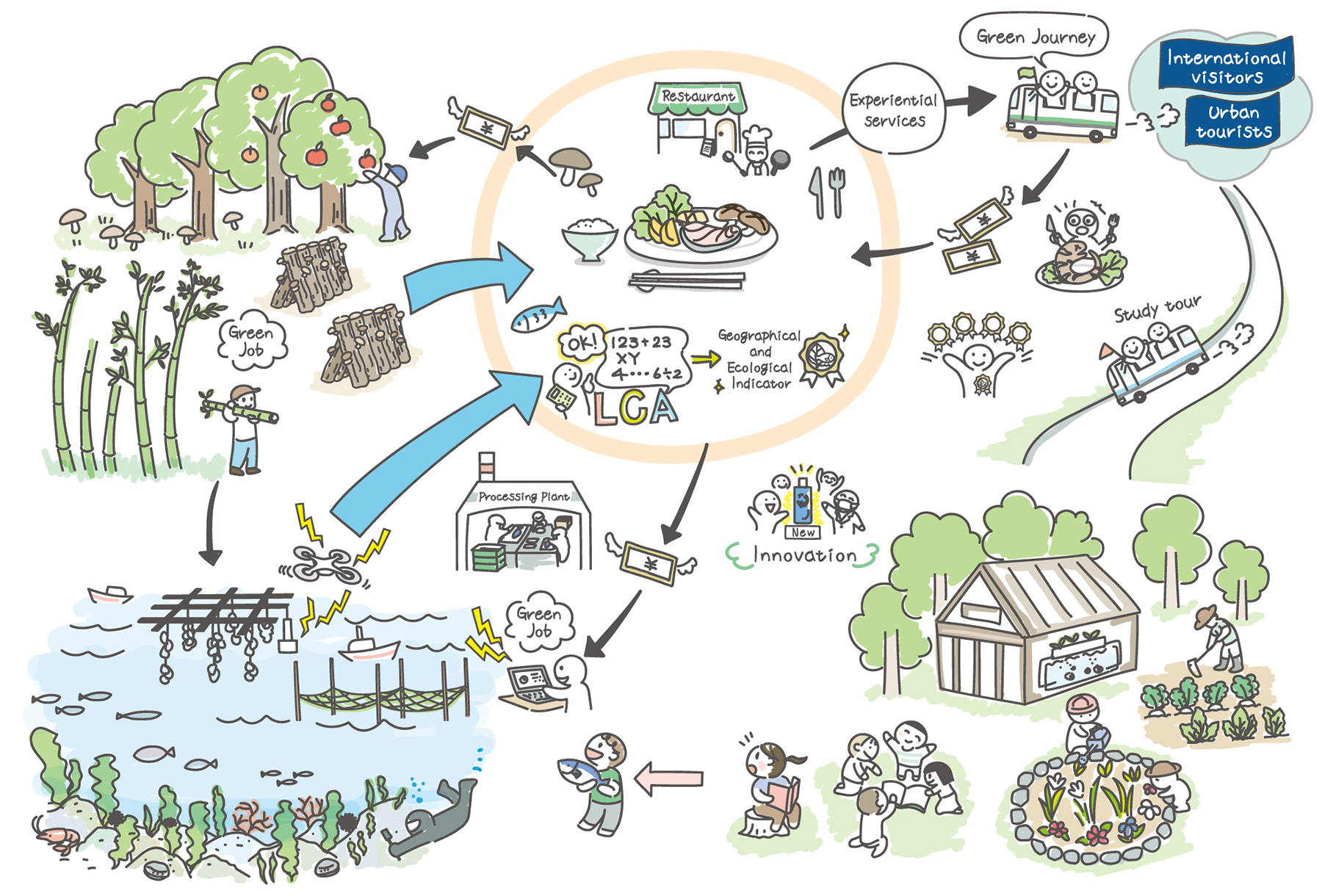
A climate-resilient food supply chain,
a community that nurtures connections across generations,
and a co-creative society where people can live enriched lives aligned with environmental sustainability.
In recent years, intensifying climate-related disasters and shifts in ocean current patterns have led to pronounced environmental changes on land and sea. In particular, marine ecosystems have undergone especially dramatic changes, significantly affecting livelihoods in regions where primary industries and food-related industries form the economic base. These impacts extend beyond the primary sector and demand that local food cultures urgently adapt to the realities of climate change.
To meet this challenge, we seek to deepen our understanding of natural capital using comprehensive observational data and to establish a robust scientific knowledge base for forecasting the future impacts of climate change on ecosystems. This advanced knowledge will form the foundation for developing strategies to conserve unique local food resource environments – notably satoyama and satoumi landscapes – which are unique human-influenced natural environments shaped and sustained by long-term human activity. Building on this knowledge, we will also collaborate with industry partners to create and expand opportunities for utilizing currently untapped or underutilized food resources that are not readily distributed in today’s markets. Through these efforts, we aim to build a food supply chain that can adapt to climate change while minimizing waste at production sites and reducing overall food loss.
Because food resources with characteristics like high variety, small production lots, and irregular availability are difficult to utilize within existing supply chain structures, new approaches are required. To overcome this, our hub is introducing a geographical environmental certification framework. This framework will help instill a new societal value system that embraces the use of food resources previously discarded for reasons such as non-standard appearance or cultural unfamiliarity. We will promote mechanisms that make better use of these overlooked resources.
Furthermore, we will maintain and develop jobs spanning the entire food supply chain as “green jobs”, and share the significance of these roles through educational communities that involve multiple generations. By doing so, we provide future generations – including high school, university, and vocational students – the option to pursue regional green jobs as a viable career anchor. As these future generations take up green jobs in their home regions,we aim to curb youth outmigration to urban areas and revitalize local economies. Through these integrated efforts, our vision is to realize regional communities where people can lead rich, fulfilling lives in harmony with nature.
Target
Four Target Areas of the Project
This project seeks to foster a green job market grounded in the principles of Gastronomy Geopolitics by focusing on the following four key targets.
Target1
Target 1 : Knowledge Creation
Building an intellectual foundation for the proper conservation, management, and sustainable utilization of natural capital
To realize the climate-resilient food supply chain envisioned in our project, consumption and production must rest on the proper management and conservation of natural capital. This requires understanding the current state of our rapidly changing natural environment and using precise observational data to manage and conserve natural capital while utilizing its resources effectively. In recent years, abrupt environmental changes in coastal areas have caused phenomena such as mass die-offs in oyster farming and color loss in nori (seaweed) cultivation. By continuously monitoring these fluctuating coastal conditions and optimizing aquaculture practices, we can simultaneously improve productivity and protect the environment. Furthermore, making use of archived data to develop predictive models of coastal environmental changes will enable more proactive and adaptive approaches for primary industries. The project also aims to deepen understanding of nutrient dynamics connecting terrestrial and coastal areas, and to promote environmental conservation that takes into account the diverse and complex impacts of industrial activities—such as forest management and wastewater treatment—on ecosystems. Crucially, the knowledge generated should not be shared only among researchers and producers; it needs to be utilized across the entire supply chain involved in food production and natural capital management. Mechanisms for knowledge dissemination—such as indicators and branding grounded in scientific knowledge—are essential, and it is necessary to establish a foundational platform to support their development.
Target2

Target 2 : Gastronomy Supply Chains
Developing innovative food supply chains that can adapt to climate change
Building on the knowledge created in Target 1, we will develop a supply chain that brings food resources produced under optimal, environmentally sound conditions to society—indirectly linking land-based activities to environmental conservation. Broad participation across sectors is crucial: not only household consumers, but also food processing companies, distributors, restaurants, and hospitality services need to understand and engage in utilizing these environmentally responsible food resources. In addition, efforts by agriculture and livestock industries to reuse by-products as fertilizer or feed, and by other industries to utilize untapped resources as ingredients for supplements or cosmetics, are necessary to fully harness nature’s riches. Promoting nutrient cycling between terrestrial and coastal areas likewise requires lifecycle management of resource flows, including the involvement of waste management businesses. Achieving these goals demands coordination across multiple government ministries – the Ministry of the Environment (responsible for managing environmental pollutants), the Ministry of Land, Infrastructure, Transport and Tourism (responsible for managing waste treatment infrastructure), the Ministry of Agriculture, Forestry and Fisheries (responsible for overseeing environmental and production management supporting food systems), and the Ministry of Economy, Trade and Industry (responsible for supporting relevant industrial activities). Together, we aim to design and standardize comprehensive guidelines for the circulation of food resources across the entire supply chain. This project aims to establish a sustainable food supply chain based on Gastronomy Geopolitics, thereby ensuring the appropriate distribution and widespread adoption of the products and services developed through the initiative.
Target3
Target 3: Ecosystem Development
Fostering market ecosystems that enable prosperous regional economies that coexist with the natural environment.
Currently, a disconnect between producers and consumers means that environmentally friendly products from primary industries are not always chosen in the market; instead, cheaper products with higher environmental footprints tend to prevail. By establishing stronger channels of engagement between producers and consumers, we can ensure that consumers have access to vital environmental context from production areas, thereby fostering informed behavioral change. When more consumers choose products from environmentally responsible producers, it is expected to create a virtuous cycle: rewarding those already practicing sustainability and encouraging more producers to shift toward sustainable practices. June 2021 saw the official launch of the Taskforce on Nature-related Financial Disclosures (TNFD), reflecting growing expectations that companies disclose not only their carbon emissions but also their efforts to conserve natural capital. In light of this, the advantages of directing investment and finance toward food production that properly manages and protects natural capital have become increasingly recognized. To support this shift, the project will work to create a market environment that enables the implementation of the environmental observation and conservation efforts outlined in Target 1, as well as the climate-adaptive food supply chains pursued in Target 2. It will also implement certification schemes and develop policy frameworks to mobilize administrative support.
Target4

Target 4 : Green Job Education
Establishing educational communities that cultivate regional green job markets
Local economies shoulder much of our food production, and managing the natural capital that underpins this production requires people with the right knowledge and skills. However, rural regions today offer relatively few career opportunities that the next generation finds attractive, so many young people are leaving for urban areas. The decline of local industries in turn shrinks tax revenues, creating a vicious cycle in which local governments struggle to fund environmental conservation. To break this cycle, jobs related to environmental management and conservation need to be created and maintained throughout the food supply chain – classified as green jobs. By sustaining such green jobs across the supply chain, we can preserve local employment opportunities while also ensuring that the food system’s environmental management and resource conservation needs are met. To do this, we urgently need to develop human resources with new skills and a deeper understanding of how changes in the environment impact the economy. Traditional education alone cannot meet this growing need. To cultivate the next generation of green talent, a collaborative approach is essential—one that integrates knowledge sharing between high schools and universities, provides governmental support to enhance educators’ skills, and fosters co-creative career education by partnering with local businesses and communities to offer hands-on learning opportunities. Ultimately, this project aims to make all local occupations both “decent work”—fulfilling and dignified—and green jobs. It also seeks to build an educational community that creates opportunities for younger generations to choose local green careers as their career anchor—that is, a core value that shapes their career choices.
Research and Development Initiatives
Research and Development Initiatives
Eight R&D tasks are being pursued to achieve the four project targets by generating co-created knowledge within the region, with the aim of solving local challenges.